Sunday, June 28, 2026
"The Fall of the House of Usher: I. Prelude"
Part of the narration at the beginning of "The Fall of the House of Usher: I. Prelude" is "the comprehension of sweet sound is our most indefinite conception." The phrase "sweet sound" alliterates, and in a way, this euphony matches the meaning.

Saturday, June 27, 2026
"The Cask of Amontillado"
After the line "Part of you dies each brick I lay" in "The Cask of Amontillado," the bass plays a phrase that represents the lyric in a way. The notes are all distinct pitches (F G Ab Bb), giving a sense of the individuality of "each," and the phrase ascends, illustrating the increasing height of the courses of brick that the narrator is laying. Since the ascent is diatonic, with the notes following each other in the scale, there's even a specific sense of each brick being placed upon the previous one.
Friday, June 26, 2026
"The Raven"
Because yester-day was the fiftieth anniversary of the release of Tales of Mystery and Imagination, I listened to the album again, and I noticed a few small features.

In the verses of "The Raven," the note values increase in the middle and at the end, corresponding to the third and sixth lines of the lyrics (according to how they're formatted on the Alan Parsons Project website) but to the second and fourth lines of this notation:

These longer values musically represent the duration of "for evermore" in the lines "That I shall hear for evermore" and "And I must hear for evermore" in the second and third verses, respectively, and in the earnestness of the request in the line "No matter how much I implore" in the third.
Wednesday, June 10, 2026
"La Sagrada Familia"
I listened to Gaudí this morning because to-day marks the 100th anniversary of Gaudí's death. I noticed the parallelism in the line "The war is won; the battle's over" in "La Sagrada Familia" and realized that this device is fitting for the song's theme (a basilica) since some sections of the Bible have a similar structure: for example, Proverbs 16:18: "Pride goes before destruction, and a haughty spirit before a fall."
Saturday, May 30, 2026
"Lucifer"
I've been reading Robert Baden-Powell's Scouting for Boys, and yester-day, I encountered a chart of the Morse code signals (on page 65). It reminded me that the album title Eve is spelt out in Morse code in "Lucifer" (the APP website notes this in the comments on the expanded edition of the album).

The part is basically a repeated, one-measure phrase (in the last iteration of each section, however, the final note drops to an C#). In the notation below, I delineated the Morse code letters by color: blue for E (•) and gray for V (• • • -).

Note that the lengths for • vary: those for the two Es are the same (eighth notes), but the initial two of the three in V (a pair of sixteenth notes) are shorter than the third (an eighth note).
Monday, April 27, 2026
Tales of Mystery and Imagination
I listened to Tales of Mystery and Imagination yester-day and for the first time noticed that the recorder part from "A Dream within a Dream" is reprised near the end of "(The System of) Doctor Tarr and Professor Fether." When I lookt into the parts more closely, I discovered that they are slightly different.

%20Doctor%20Tarr%20and%20Professor%20Fether%20-%20reprise%20of%20the%20phrases%20from%20'A%20Dream%20within%20a%20Dream,'%20starting%20at%20~3.28.png)
The recorder in "A Dream within a Dream" (starting at ~1:03) is something like this:

In "(The System of) Doctor Tarr and Professor Fether," the recorder starts at ~3:29 and repeats throughout the rest of the song:
%20Doctor%20Tarr%20and%20Professor%20Fether%20-%20reprise%20of%20the%20phrases%20from%20'A%20Dream%20within%20a%20Dream,'%20starting%20at%20~3.28.png)
The keys are different, and some note values have been shortened in "(The System of) Doctor Tarr and Professor Fether," but all of the intervals are the same.
"A Dream within a Dream" and "(The System of) Doctor Tarr and Professor Fether" are the first and last songs, respectively, on the first side of the original vinyl album. Since this recorder part appears near the beginning of "A Dream within a Dream" and in the coda of "(The System of) Doctor Tarr and Professor Fether," it creates a sort of book-ending effect.
Thursday, April 9, 2026
"(The System of) Doctor Tarr and Professor Fether"
I was thinking about "(The System of) Doctor Tarr and Professor Fether" yester-day and had a small realization about the line "Just what you need to make you feel better" in the lead vocals at ~1:45. "Better" is sung with a melisma (I think it's something like Eb F G G F Eb G G F Eb F Eb C, but it gets more difficult to follow at the end), and this articulation gives some sense of the comparative nature of this adverb (more notes for a higher degree).
Wednesday, January 28, 2026
"Limelight"
Last month, I listened to Stereotomy (Sessions). I noticed some connections between the music and lyrics in "Limelight," and this morning, I listened to Stereotomy again in order to confirm that they're also in the final version. During the line "After all the years of waiting," most of the instruments drop out, and this musical rest matches the "waiting." In the last two iterations of the following line ("I'm gonna show them all"), the instruments come back in under "all," representing this multitude.
Sunday, November 30, 2025
"Dancing on a Highwire"
I recently listened to a compilation album of Colin Blunstone (titled Collected) and noticed a very small feature in "Dancing on a Highwire." The alliteration in the line "You need to be so sure" lends a slight sense of degree.
Saturday, October 4, 2025
"Light of the World"
The lines "So many ways / So many words" at the end of "Light of the World" are each sung to notes of all different pitches (G F E C both times), and this articulation provides a sense of breadth (for "so many").
Friday, October 3, 2025
"Limelight"
I listened to Stereotomy yester-day and noticed a couple small features.
Under the lines "I ain't gonna change my mind" and "Nothing can change my mind" in "Limelight," the bass plays three notes of the same pitch (Bb). Because the pitch is maintained, there's a sense of this constancy (not changing).
When I found the specific pitch, however, I also noticed that "mind" is sung with a melisma (C Bb), so while the sentiments are negated, there is a sense of "chang[ing]."
Friday, April 4, 2025
"One Good Reason"
I ran across the phrase "one good reason" yester-day, which reminded me of the Alan Parsons Project song. This morning, I figured out the chord progression in order to confirm a suspicion I had. Unless I'm mistaken, the chords for the verses are something like this (with vertical lines dividing the measures):
C major | C major | C major | C majorC major | C major | C major | C majorEb major | Eb major | F major | F majorAb major | F major | C major | C major
C major occurs far more frequently than any other chord, and it's the only chord for the first two lines, where it's held for eight sequential measures. Because the song stays on just one chord for so long, there's a sense of the singularity of "one good reason." Alternatively, there's a sense of the stalled nature of the exchange, with the narrator refusing to do anything until he receives this "one good reason."
This same sort of feature is also present in the coda, where the phrase "one good reason" is repeated over a C major chord.
Friday, March 21, 2025
Pyramid
I was thinking about Pyramid yester-day and realized that it (and "Pyramania" in particular) has an appropriate theme for the Alan Parsons Project's third album since pyramids have three edges (when viewed from the side, at least).
Wednesday, March 19, 2025
"The Turn of a Friendly Card (Part One)" and "The Turn of a Friendly Card (Part Two)"
I listened to The Turn of a Friendly Card yester-day to mark Eric Woolfson's eightieth birthday, and I noticed some significance in the structure of the lyrics in the title tracks (part one and part two), specifically in the lines "But the game never ends when your whole world depends / On the turn of a friendly card." The sense is spread across the line break, so the listener is left waiting for the line "On the turn of a friendly card" to complement "depends" and finish the meaning. To some degree, this structure (with the second line necessary to make sense of the first) matches the "depend[ency]" in the lyrics.
Sunday, December 8, 2024
"Silence and I"
Recently, I was thinking about "Silence and I" and realized that there are some ways in which the vocal melody for the lines "We're two of a kind / Silence and I" matches the meaning. The lines are sung to musical phrases something like these:


(I'm still not very sure of the key, but I think it's Bb minor.)
Excepting the initial note of the first phrase, the two phrases have the same melodic shape and note values, so there's a parity between the two phrases in the same way that "Silence and I" are "two of a kind."
"Two of a kind" is also represented musically in that (again excepting the initial note of the first phrase) each phrase consists of two pairs of two pitches (Bb & C and C & Db).
Friday, November 8, 2024
"The Same Old Sun"
Yester-day, I was thinking about the vocal melody in "The Same Old Sun" and noticed a small but significant contrast between different sections.
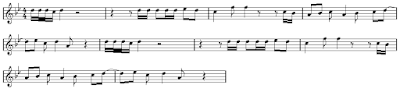


The first section ("Tell me what to do / Now the light in my life is gone from me...") is sung to a melody something like this:
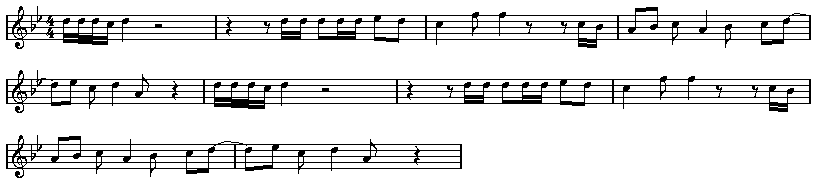
The following section ("Taking my life / One day at a time / Cause I can't think what else to do...") is sung to a melody something like this:

The first section has a considerable number of sixteenth notes, but the following section includes longer note values, the longest of which are half notes tied to eighth notes. This increase in note duration musically demonstrates "Taking some time / To make up my mind."
When I did the notation, I noticed that the melody is slightly different when this section is repeated:

There's a longer pause between "Taking some time" and "To make up my mind" (in the fifth measure), and this also illustrates the meaning of those lyrics.
---
For what it's worth: I wrote about a different aspect of the vocal melody in "The Same Old Sun" back in May.
Thursday, November 7, 2024
"Hawkeye"
About five years ago, I had a vague feeling that some of the saxophone part in "Hawkeye" was similar to a part in a Paul McCartney song. I listened to Vulture Culture a few days ago and finally placed what I was thinking of.

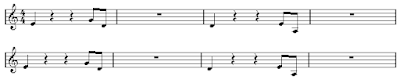
At ~2:20 in "Hawkeye," the saxophone starts playing something like this, which repeats until the end of the song:

There are some similarities between this and the vocal chant ("Ho hey ho / Ho hey ho...") in Paul McCartney & Wings' "Mrs. Vandebilt" on Band on the Run:

(This also appears near the end of "Picasso's Last Words (Drink to Me)," albeit a whole step lower.)
Each is an eight-measure section, and at the end of (almost) every other bar, there's a pair of descending eighth notes (always a fifth in "Hawkeye," but alternating between fourths and fifths in "Mrs. Vandebilt").
While there's a similarity between these two parts, I don't know if this is just coincidental or if it's an indication of Paul McCartney's influence (whether conscious or not).
One of the bonus tracks on the Vulture Culture CD is a demo version of "Hawkeye," and in the liner notes, Alan Parsons comments, "This is one of my demos," so I'm assuming he had more to do with this particular track than Eric Woolfson did. Of course, Parsons workt with McCartney in the Beatles on Let It Be and Abbey Road and also on McCartney's Red Rose Speedway (the album before Band on the Run), and in this interview (in the section beginning ~21:04), he mentions being impressed with McCartney's musical ability (with particular reference to the Moog solo in "Maxwell's Silver Hammer").
Friday, September 20, 2024
"Ask No Questions"
In "Ask No Questions," "ev'rything" in the line "In your eyes, I see ev'rything" is sung with a melisma (B C B A G), giving a sense of breadth.
Thursday, September 19, 2024
"Avalanche"
I listened to Keats last week and noticed small features in a couple songs.
In "Avalanche," "more" in the line "And we'll be hurt by love some more" in the section starting at ~3:00 is sung with a melisma (D C Bb A), giving a sense of its meaning.
Wednesday, August 14, 2024
"Let's Talk about Me"
Yester-day, I ran across the word ouroboros, which reminded me of Vulture Culture. As I was thinking about "Let's Talk about Me," I realized that there's significance to the moment at ~0:44 where almost all of the instruments and the "oral rendition" drop out, leaving only a piano and the lead vocal. When these other elements are suddenly stripped away, the vocal becomes the focus, and this matches the sentiment in the lyrics there: "Let's talk about me for a minute."
Subscribe to:
Posts (Atom)